
Electronic Visit Verification (EVV) is a federal mandate requiring ABA providers to digitally record key details of every therapy session — from timestamps and GPS location to provider identity and service type. Getting it right protects your revenue, prevents claim denials, and keeps your practice audit-ready. This guide breaks down what EVV compliance means for ABA practices, how requirements vary by state, and what operational pitfalls to avoid.
Key takeaways:
- Inaccurate EVV records lead to delayed and denied claims and audit issues — accurate, real-time data capture at every session is non-negotiable.
- EVV requirements vary significantly by state and payer, so practices must verify compliance rules through official Medicaid and MCO sources.
- Disconnected software systems and reactive billing reviews are major compliance risks — integrated, daily validation workflows are the fix.
What EVV compliance means for ABA practices
Defining EVV compliance in ABA
Electronic Visit Verification compliance for ABA practices means keeping a clear record of each session’s key details. It is like having a secure digital note that shows care was actually given. Submitting an incomplete EVV log is the behavioral health equivalent of submitting unsigned insurance paperwork to a payer.
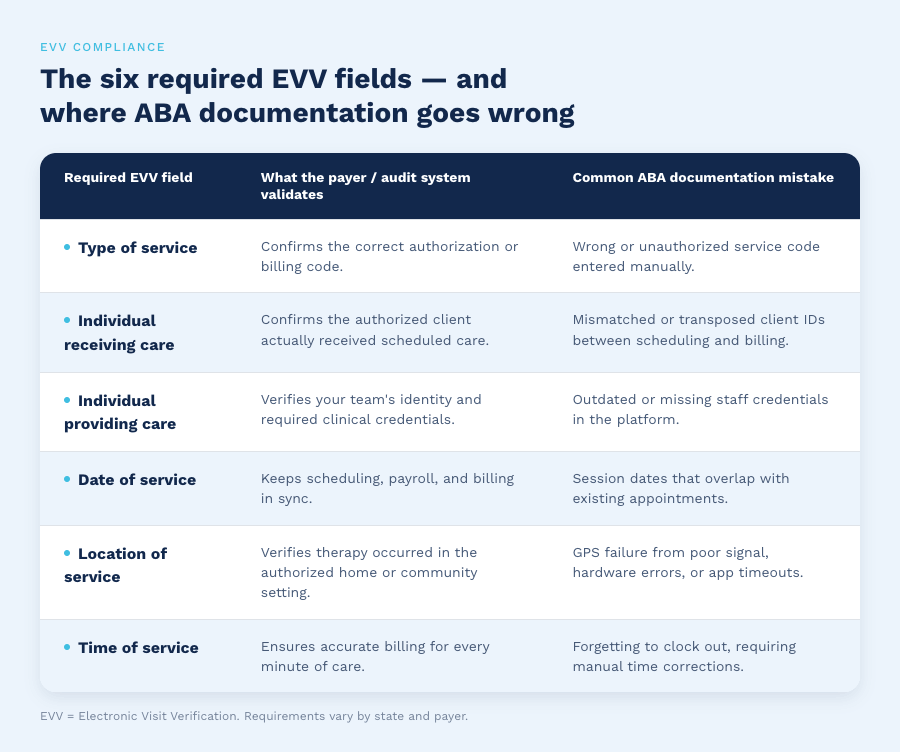
To meet compliance rules, each record needs to include specific details:
- Timestamps: Exact check-in and check-out times for the session
- Provider identity: Identification of the specific therapist delivering care
- Individual receiving care: Identification of the client receiving the services
- Service type: The authorization or billing code tied to the therapy
- Location verification: GPS or coordinate data confirming where the session occurred
Compliance hinges on aligning your daily operations with requirements. All of these data points need to appear accurately in your billing paperwork to prevent processing delays or immediate insurance holds.
How EVV differs depending on your location
The federal 21st Century Cures Act set the groundwork, but EVV requirements for ABA providers vary from state to state. Each state can design and manage its own system, so what you need to do for Medicaid EVV ABA regulations depends entirely on where your practice is located.
States generally choose from five main EVV models (PDF), according to CMS guidelines. Knowing which one your state uses helps you properly configure your practice management software:
- Provider Choice Model: Allows individual ABA practices to select, contract, and fund any EVV vendor that meets the state's data criteria.
- Open Choice Model: Provides a free, state-sponsored system or data aggregator, but allows practices to use their own preferred third-party software as long as it integrates securely.
- State-Mandated External Vendor Model: Contracts with a single external vendor. Every provider in that state must use this system to log visits.
- State-Mandated In-House Model: Builds, maintains, and operates its own proprietary EVV system, requiring all local providers to utilize the government’s direct platform.
- Managed Care Plan (MCP) Choice Model: Delegates the decision to insurance payers. Individual Managed Care Organizations select and mandate which EVV systems their contracted network providers must use.
Besides the software, the details you need to gather can also depend on your location. Each state may have its own way to confirm visits, like:
- Real-time GPS location coordinates or geofencing to prove where a session occurred.
- Therapist check-in and check-out tracking to record precise session length.
- Digital parental or guardian signatures collected at the immediate conclusion of a visit.
- Service codes that link directly to pre-scheduled appointments.
These requirements can also change depending on several operational variables, including:
- Funding source: The financial regulations tied to the programmatic budget.
- Insurance payer policies: The individual guidelines set by commercial or private health networks.
- Service type: The specialized delivery model or clinical code utilized for the session.
- Therapy setting: Whether the treatment takes place in the client's home or a clinic environment.
Even within a single state, different managed care organizations (MCOs) might set their own unique documentation rules or distinct workflows for submitting claims.
Helpful guidance for multi-state ABA practices
If your ABA organization works in more than one state, don’t assume what works in one place will work everywhere. Since requirements can be different depending on location, practices with multiple sites need flexible administrative processes.
To maintain compliance without bottlenecking daily operations, multi-state agencies may require:
- State-specific workflow reviews: Auditing your clinical and administrative routines against the EVV model mandated by each local Medicaid authority.
- Payer-specific documentation processes: Mapping your internal logging standards to match the structural differences required by regional commercial payers and MCOs.
- Flexible software systems: Utilizing adaptable technology that can ingest distinct data sets, accommodate various state aggregators, and adjust parameters on a regional basis without forcing you to switch apps entirely.
Where ABA practices can find official EVV guidance
Relying on third-party summaries or word-of-mouth can lead to expensive mistakes. Since rules are enforced by payers and government agencies, always double-check requirements using official state and federal sources.
The most authoritative primary sources for verifying compliance protocols include:
- CMS Electronic Visit Verification (EVV) Guidance: The federal resource on the framework of the 21st Century Cures Act.
- State Medicaid agency directories: Official government listings that direct you to the department overseeing local healthcare mandates.
- Individual state Medicaid websites and provider bulletins: The primary publication channels for real-time policy changes, system updates, and billing modifications.
- Managed care organization provider portals: Payer-specific dashboards that detail localized documentation expectations and claim-matching procedures.
- Official State EVV implementation pages: Dedicated state portals containing approved vendor lists, integration specifications, and technical user guides.
Because EVV requirements can evolve over time, ABA practices benefit from regularly reviewing state Medicaid guidance and using systems that can adapt to changing operational requirements.
Why EVV compliance directly impacts claims
Payers routinely use background digital data to confirm that services occurred exactly as billed before they release funding. When records are incomplete or contain mismatched details, insurance companies may delay or deny claims.
The financial stakes of administrative errors are clear:
- Massive revenue leakage: Peer-reviewed health compliance studies published by the National Institutes of Health reveal that Medicaid-participating providers lose up to 18% of potential revenue due in part to these administrative frictions.
- The cost of rewriting mistakes: According to data from the American Medical Association, manually tracking down, correcting, and resubmitting a single denied claim costs an agency about $25 in wasted administrative labor.
- Permanent losses: Medical Group Management Association reports that up to 60% of denied claims are never resubmitted, resulting in permanent revenue loss.
This can happen in any busy office. Picture an office billing specialist getting ready to send in a claim for Medicaid, only to see that an RBT forgot to clock out for a session on Friday afternoon. Without an end time, the system cannot validate the data. If the mismatch isn’t fixed, payment gets delayed until the right info is found.
In short, if your EVV records are accurate, you’ll get paid faster. Compliance is built through consistency, not cleanup. Staying organized helps ensure you meet ABA billing compliance rules and keep money coming in predictably.
What data EVV captures — and why accuracy matters
Core EVV data requirements
To comply with federal guidelines, an EVV system must capture specific core data elements for each home- or community-based session. Each data point serves a distinct regulatory purpose, providing the baseline verification that insurance payers and auditors require to validate a claim.
Why data accuracy matters on the ground in ABA
In daily practice, these data points act as a defensive shield against compliance risks. Consider a typical clinical scenario: a BCBA supervisor logs into the practice management platform on a Monday morning to review the billing files of the previous week.
Before pushing the claims through to the billing department, the supervisor cross-references the RBTs' clinical session notes with the automated EVV data logs. If the supervisor spots an entry where the GPS location coordinates place the therapist outside the client’s designated community area, or notices a timestamp that overlaps with another scheduled client, they can flag the record immediately. Catching these discrepancies before data enters the claims stream prevents automatic rejections.
If everyone uses the same steps to document sessions, mistakes are less likely. Getting into the habit of entering data correctly helps payments go through without a hitch.
Why disconnected documentation creates compliance risk
Maintaining compliance requires total operational alignment. If your software tools exist in separate silos, your ABA documentation compliance is highly vulnerable to errors.
To preserve compliance and protect your revenue, four critical operational records must perfectly mirror each other:
- The schedule: Proves that the session was authorized and planned.
- The EVV log: Provides an unalterable digital receipt of the precise time and location.
- The session notes: Documents the clinical progress and medical necessity.
- The billing claim: Translates the completed care into a request for reimbursement.
The high cost of disconnected systems
When these critical records live in separate software applications, they cannot communicate. This disconnect increases two major operational risks:
- Mismatched timestamps: A clock-in time in a standalone EVV app that conflicts with the session start time written in the documented clinical record or recorded on a scheduling calendar.
- Missing documentation issues: A clinical record that is fully completed and signed, but the accompanying digital EVV receipt doesn’t link to the file. In this scenario the entire service unit is technically non-compliant.
The reality of manual reconciliation
In a disconnected software ecosystem, your office staff members have to act as a manual data bridge, patching the administrative gaps. Consider how this operational friction plays out for a billing specialist at the end of a month:
- The manual workflow: The specialist must export a hefty spreadsheet of timestamps from a standalone EVV tracking tool and open it side-by-side with a billing summary report generated from the agency’s scheduling system.
- The administrative burden: To ensure compliance, the specialist has to manually cross-reference hundreds of lines of data, matching every single GPS checkout coordinate and digital timestamp to a specific client appointment file.
- The bottleneck: If an RBT checked in five minutes late to a home session because of poor cellular reception in a rural neighborhood, the standalone app logs a data exception. The specialist must halt the entire billing production line to investigate the timestamp variance, pull the therapist's clinical note to verify the true session duration, and manually overwrite the entry before the claim can safely go out.
The core compliance takeaway is clear: integrated workflows drastically reduce manual reconciliation work and all but eliminate compliance exposure. Natively linking your systems allows data to flow automatically from the session straight to the claim, keeping your practice audit-ready without the administrative strain.
Common EVV compliance pitfalls ABA practices should avoid
Inconsistent staff workflows
The success of any ABA EVV compliance strategy depends almost entirely on the daily actions of your field staff. When data collection procedures are unpredictable or poorly defined, it directly compromises your billing pipeline. Inconsistent staff procedures may increase the number of incomplete EVV records.
When therapists lack a single, standardized routine for logging their time and location, documentation gaps become inevitable due to compounding operational challenges:
- The multitasking burden: Field staff must balance clinical data tracking, behavior management, and parent communication during a session.
- The app-switching bottleneck: Providers are required to pivot between a clinical app for session notes, a calendar app for schedules, and a third standalone app for EVV. This chaotic workflow makes it easy to forget to check in or out of a session.
Consider how this looks during a normal afternoon home session. An RBT arrives at a client's house, greets the family, and immediately opens their clinical tool to prepare for baseline data collection. Because the EVV tracker lives in a completely separate app, the therapist jumps straight into the clinical routine and forgets to open the third-party app to clock in. By the time they realize the mistake an hour later, the timestamp is completely inaccurate, triggering a manual correction workflow for the back office.
Building long-term compliance consistency requires the use of highly repeatable workflows backed by clear staff accountability. When the administrative expectation is identical for every single session, compliance shifts from an extra chore into an automatic habit:
- Clear expectations: Ensure providers know exactly when and where verification needs to occur, specifically at the immediate point of contact with the client.
- Proactive accountability: Holding teams accountable to a single, static standard ensures data integrity is high from every day.
Ultimately, simpler operational processes improve staff adoption and reduce recording errors. Stripping away unnecessary administrative friction makes it easier for your clinical team to get documentation right the first time.
Waiting until billing to catch errors
A major operational pitfall for many ABA agencies is treating visit verification as a month-end task. When an organization waits until the final claims submission window to review logs, administrative delays are virtually guaranteed. Only identifying EVV issues during the billing cycle forces your team into a constantly reactive state. Reactive corrections create far more long-term compliance risk than proactive validation workflows.
Shifting to a proactive, daily validation routine drastically reduces both EVV claim denials and month-end administrative cleanup.
- The Reactive Bottleneck: Imagine a billing team sitting down on the first of the month to submit a clean batch of claims. While running a pre-submission report, they discover that an RBT missed multiple check-out timestamps three weeks prior.
- The delayed resolution: The billing staff must stop the submission process for those particular claims, email the supervisor and wait for the therapist to manually verify their hours from weeks ago.
- The financial impact: While this back-and-forth occurs, these particular claims sit on hold. This delays your reimbursement timeline for weeks over a simple office error, which could have been fixed in two minutes if caught the next day.
Earlier verification directly protects your reimbursement timelines. Audit readiness starts during the session, not during billing. Catching errors within 24 hours helps your data trail remain clean and your cash flow predictable.
To transition your back office from a reactive cleanup team to a proactive compliance team, implement this daily routine:
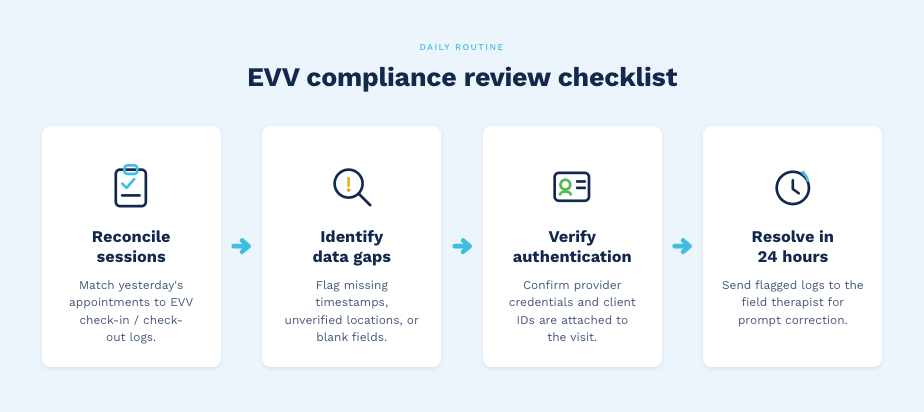
Daily EVV compliance review checklist
- Reconcile prior day sessions: Cross-reference yesterday's completed appointments on the schedule against the recorded EVV check-in and check-out logs.
- Identify data gaps: Run an immediate exception report to flag missing timestamps, unverified location coordinates, or blank fields.
- Verify authentication: Confirm that required provider credentials and client identifiers are correctly attached to the visit record.
- Resolve discrepancies within 24 Hours: Send flagged logs back to the specific field therapist immediately for correction while the session details are still fresh in their mind.
Treating EVV as a separate task
When visit verification is treated as an isolated administrative chore bolted onto the side of daily operations, business efficiency suffers. To protect your revenue, EVV should function as a fully connected component of your standard documentation and billing workflow. Isolating it as a standalone task creates disconnected data trails that jeopardize your practice's financial health.
Operating with disconnected EVV processes introduces two major liabilities into a practice:
- Compounded duplicate work: Forcing administrative staff and field therapists to re-enter the exact same operational data across multiple software applications wastes valuable clinical hours on manual compliance.
- Elevated audit risk: When information must be manually copied from one system to another, clerical the chance of errors multiplies.
Consider how this structural disconnect plays out for an ABA team on a daily basis. An RBT finishes a community-based session and logs their exact hours and GPS coordinates inside a standalone, state-mandated EVV app. Next, they open a separate clinical data-collection tool to write their formal session notes, manually typing in the arrival and departure times again. At the end of the week, the office billing specialist takes over, manually entering those exact same times a third time into a separate billing system to generate an insurance claim.
This manual data re-entry creates three places where a single typing mistake or a minor numerical error can happen. If an auditor pulls those files and finds that the EVV timestamp says 3:05 PM but the clinical note and billing claim say 3:00 PM, that entire service unit could be flagged.
Integrated workflows improve long-term compliance sustainability. When your systems work together, it’s easier to stay on track. Entering information once saves time and helps you avoid mistakes, manual duplicate labor, and stressful payer audits.
How ABA practices can build a strong EVV compliance foundation
Building a sustainable strategy for ABA documentation compliance cannot rely on a series of last minute fixes before billing deadlines. Instead, long-term operational health depends on three foundational pillars:
- Procedural consistency: Harmonizing data capture for each provider on every shift.
- Clear internal accountability: Assigning ownership of the daily log reviews to specific team leads.
- Connected software workflows: Eliminating manual data steps between the systems.
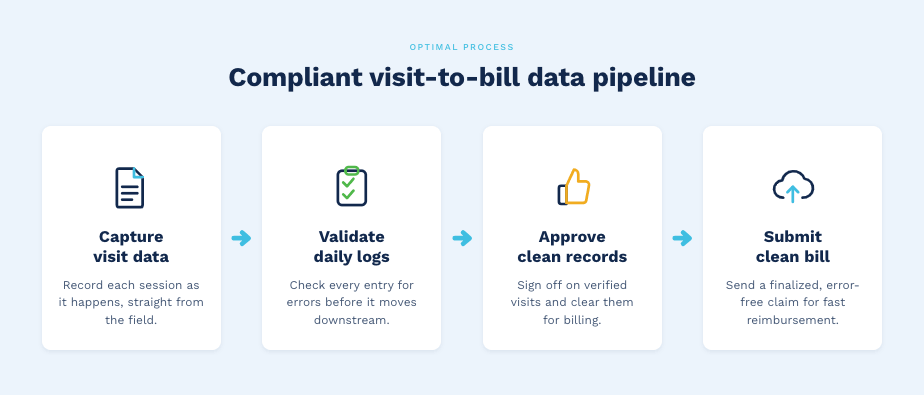
To safeguard your revenue, your practice must standardize how visits are verified, reviewed, and approved long before an insurance claim is ever generated. Shifting from a reactive cleanup model to a structured validation pipeline ensures errors are identified then eliminated.
An compliant data pipeline should follow a sequential workflow:
Capture visit data → Validate daily logs → Approve clear records → Submit clean bill
Catching missing data early
In practice, this foundation relies on daily, proactive supervision rather than waiting for an end-of-month crisis. For example, a clinical director or regional supervisor can begin each morning by opening their administrative dashboard to review an automated EVV exception report. If an RBT forgot to log out of a session the prior afternoon, or if a cellular dead zone caused a GPS location verification to drop, the exception report flags that specific appointment immediately.
Because the issue is caught within a day or so of the session, the supervisor can immediately contact the therapist to verify the hours while the details are fresh in their mind.
This quick intervention keeps the data accurate and the billing cycle moving forward. This proactive approach to compliance review can reduce audit stress and claim corrections over time.
For a comprehensive breakdown of practical implementation strategies, read our article on operational EVV workflows.
How Office Puzzle simplifies EVV compliance
Meeting federal and state regulations shouldn't add an extra administrative burden to your clinical team's daily schedule. Office Puzzle addresses the stringent requirements of the 21st Century Cures Act by functioning as an all-in-one ABA practice management software platform with built-in EVV functionality.
Because the system features automated visit verification capture, it completely eliminates the need for your providers to download, track, and troubleshoot standalone EVV apps.
Connected scheduling and billing in action
Instead of dealing with a fragmented software ecosystem, your team operates within a single, connected workflow. Consider how smoothly a typical workday runs when your systems are unified:
- The provider's flow: An RBT logs into Office Puzzle on their tablet to view their daily schedule. When they arrive at the client's home, they click to start the session inside the same interface where they collect clinical data and write their session notes.
- The automated capture: In the background, the platform automatically logs the precise start time, end time, and GPS location coordinates. There are no extra apps to open and no separate logins to manage.
- The back-office flow: The moment the therapist signs off on the medical record, that verified EVV data directly links to the appointment. The billing team can instantly review the complete file, validate compliance and push a clean claim directly to the payer.
Natively linking your clinical and billing workflows is an effective way to eliminate manual data entry errors, and simplify your long-term audit readiness.
Robust compliance made accessible
Office Puzzle provides comprehensive compliance security without complicated pricing models or hidden fees:
- Predictable pricing: $19.99 per user per month for all-inclusive features.
- Complete flexibility: Maintain full control over your business operations without long-term contracts.
- Risk-free evaluation: Fully guided 30-day free trial with no credit card required.
If your admin team is still manually cross-referencing spreadsheets and chasing down missing timestamps, your workflow needs attention. It’s time to evaluate whether your current software truly supports stress-free EVV compliance. Explore how a single unified platform can protect your revenue and give your clinicians their time back.
Final thoughts on EVV in ABA practices
Attaining true ABA EVV compliance doesn’t have to mean inundating your team with stacks of paperwork. Sustainable compliance at its core consists of two fundamental elements: accurate documentation and repeatable daily workflows on the ground.
Standardizing how data is captured, checked and validated daily is one of the most effective ways to eliminate costly EVV claim denials. Over time, this approach can reduce the administrative burden on your back office and free them up to focus on supporting clinicians and expanding client care.
Protecting your revenue from future payer audits requires looking critically at your current operational foundation. Take a moment to evaluate whether your existing technology stack truly supports an automated, audit-ready process, or if disconnected tools are creating unnecessary vulnerabilities for your business.
To help you design a turn-key verification process for your team, explore our detailed article on setting up an operational EVV workflow.
Frequently asked questions
What is Electronic Visit Verification compliance for ABA?
EVV compliance involves capturing and securely maintaining the required visit verification data for every applied behavior analysis session delivered in home or community settings. It acts as a permanent, digital receipt that objectively proves that an authorized healthcare service was delivered as billed.
What data does EVV require ABA providers to collect?
Specific state mandates vary under Medicaid guidelines. Federal frameworks require the capture of six core data elements:
- Timestamps: Precise session start and end times
- Provider identity: Verification of the therapist delivering care
- Individual receiving care: Clear identification of the authorized client
- Service date: Calendar day the care took place
- Service type: Billing or authorization code used
- Location verification: GPS or geographical coordinates proving where the session occurred
Can incomplete EVV records cause claims denials?
Yes. Insurance payers regularly cross-reference billing files with background EVV data before releasing funds. Missing timestamps, unverified locations, or clerical data differences between your clinical notes and your EVV logs will flag the system, often triggering delayed processing or denied claims.
How can ABA practices improve EVV compliance?
Practices can improve their compliance metrics by shifting from a reactive model to a proactive operational approach. This includes:
- Standardizing staff workflows: Creating a single, unvarying routine for logging session data at the point of care.
- Enforcing staff accountability: Ensuring field therapists understand the direct financial impact of precise tracking.
- Proactive daily validation: Reviewing system exception reports within 24 hours to catch and fix errors while the details are fresh.
- Connecting systems: Eliminating standalone tracking apps that force staff to manually copy data between software tools.
What should ABA providers look for in EVV software?
ABA providers should look for a unified, all-in-one practice management platform where scheduling, billing, clinical documentation, and EVV run on a single database. A compliant system must offer automated data capture and workflow simplicity. This allows RBTs to verify their visits within the same interface they use to collect clinical session data. This removes duplicate data entry and prevents the data mismatches that cause billing rejections.
References
- 21st Century Cures Act, Pub. L. No. 114-255, § 12006, 130 Stat. 1033. (2016). https://www.congress.gov/114/plaws/publ255/PLAW-114publ255.pdf
- American Medical Association. (2014). The administrative burden of health insurance: Standardization of claims and billing activities. https://www.ama-assn.org/practice-management/claims-processing/no-more-secrets-insurer-claim-edits-come-light
- American Medical Association. (n.d.). No more secrets: Insurer claim edits come to light. https://www.ama-assn.org/practice-management/claims-processing/no-more-secrets-insurer-claim-edits-come-light
- Centers for Medicare & Medicaid Services. (2018, May 16). Electronic visit verification (EVV) is required under the 21st Century Cures Act [CMCS Informational Bulletin]. U.S. Department of Health and Human Services. https://www.medicaid.gov/federal-policy-guidance/downloads/cib051618.pdf
- Centers for Medicare & Medicaid Services. (n.d.). EVV: Enhancing quality of care [Presentation]. U.S. Department of Health and Human Services. https://www.medicaid.gov/medicaid/downloads/evv-enhance-quality.pdf
- Giles, J. (n.d.). Claims denials: A step-by-step approach to resolution. Journal of AHIMA. https://journal.ahima.org/page/claims-denials-a-step-by-step-approach-to-resolution
- Medical Group Management Association. (2023). Optimizing the revenue cycle: Key performance indicators and benchmark data for medical practices [White paper]. https://www.mgma.com/getkaiasset/64027d0a-cff9-43c6-8b43-17d6588d2413/PRCM-KPIWhitePaper-Final-19April23.pdf
- Zhu, J. M., Renfro, S., Watson, K., Deshmukh, A., & McConnell, K. J. (2024). Administrative frictions and the mental health workforce. JAMA Health Forum, 5(3), Article e240207. https://doi.org/10.1001/jamahealthforum.2024.0207