
Key takeaways
- Most ABA denials start before the claim is submitted, which is why prevention beats appeals.
- Authorization is the costliest, most preventable trigger. It has to be visible at scheduling, not discovered at billing.
- A denial is a documentation problem before it's a billing problem. The note and the claim have to agree.
Every denied ABA claim is money you already earned, sitting in rework. A denial is usually a documentation or workflow problem long before it's a billing problem – that means it’s preventable.
This article offers practical action you can take and resources to help you reduce claim denials. Read on to learn:
- Why ABA claim denials really happen (and see denials organized by where they trigger in the claim lifecycle).
- How to build an ordered, role-assigned prevention workflow (to stop denials before claims are ever filed).
- Download the ABA denial prevention checklist.
Why ABA claims get denied: the real taxonomy
When the HHS Office of Inspector General audited Indiana's Medicaid payments for ABA, every one of the 100 sampled enrollee-months included at least one improper or potentially improper claim line. The deficiencies read like a denial checklist:
- unsupported code billing
- excessive units
- overlapping service times
- and missing or inadequate session notes and signatures.
This is just one audit in a series of planned audits, so the pattern is national.
It’s useful to think about denials as a full lifecycle instead of just a list of reasons. Each denial starts at a specific point, has a specific fix, and has a specific owner. When you organize them that way, prevention becomes assignable.
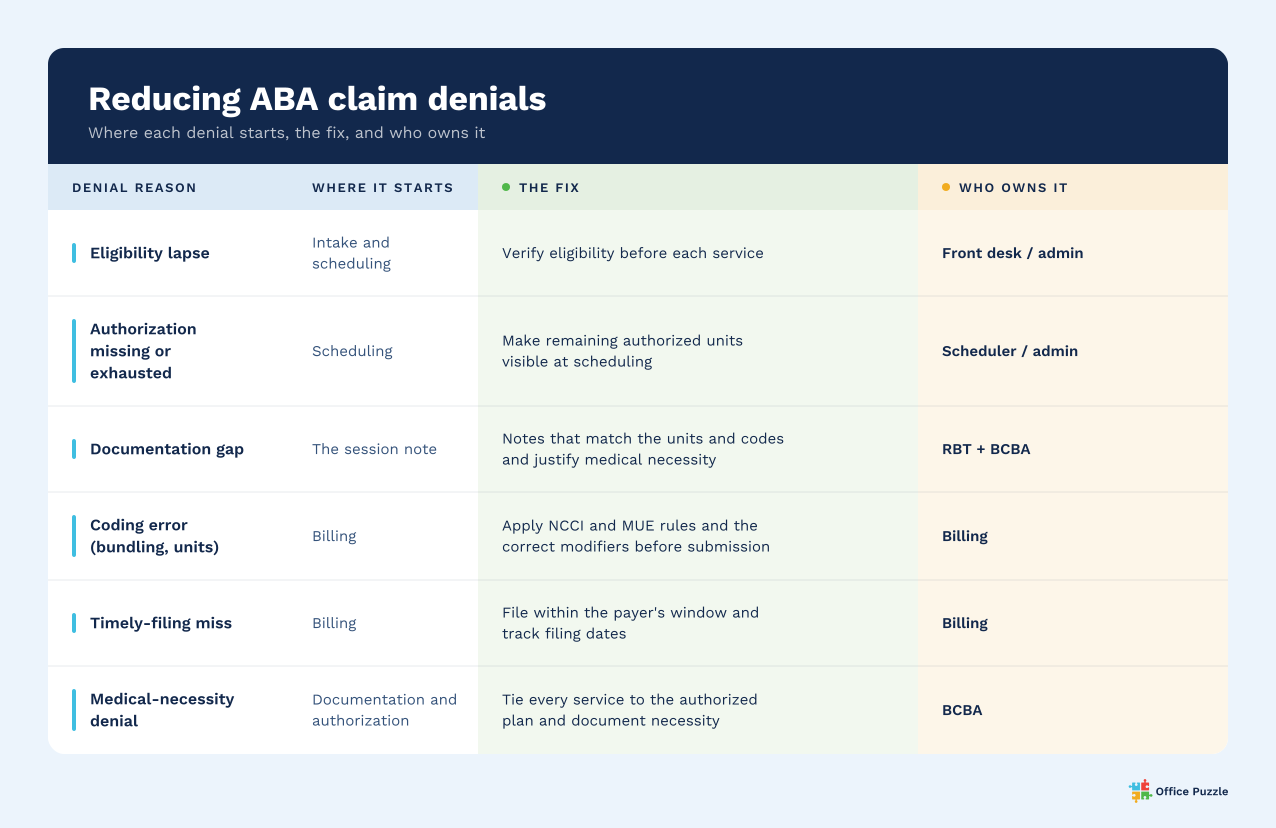
The costliest trigger: authorization
Authorization problems are among the most common and most expensive denials, and they're almost entirely preventable. A claim gets denied when a service is delivered without an active authorization, or after the approved units are already used up. The root of the problem is structural. Because clinicians usually can't see authorization status during a session, nobody notices the issue until it hits billing, long after the service is done and can't be undone.
The fix is operational. Make remaining authorized units visible at the point of scheduling, so a session is never booked or delivered outside approved limits in the first place. That's the difference between catching the problem at the keystroke and discovering it at the clawback. Because authorization rules are set by each payer, the cleanest way to enforce them is to configure them once per payer.
The prevention workflow
This is the proprietary system billing services are built on that isn’t typically broken down and shared with clear ownership. Download our ABA denial prevention visual guide that further breaks this process down into an ordered checklist with clear role assignments, designed specifically to intercept errors before they can slip through the cracks.
- Admin eligibility check: Before each service, the admin team verifies active insurance eligibility to ensure the session is covered.
- Scheduler / admin authorization check: When scheduling a session, rather than waiting for billing, the team confirms an active authorization and remaining units.
- RBT and BCBA documentation: Clinicians document sessions in real time, ensuring notes exactly match the billed units and codes while justifying medical necessity.
- Billing code compliance: Before submission, the billing team applies NCCI procedure-to-procedure edits, MUE unit caps, and correct modifiers for any concurrent ABA billing codes.
- Billing pre-audit check: The billing team runs a pre-billing check to ensure the clinical session note and the final claim match.
- Billing timely-filing tracking: The billing team files the claim within the payer's specific timely-filing window and logs the exact filing date.
The following is the same workflow, as a set of checkpoints the claim passes before it goes out: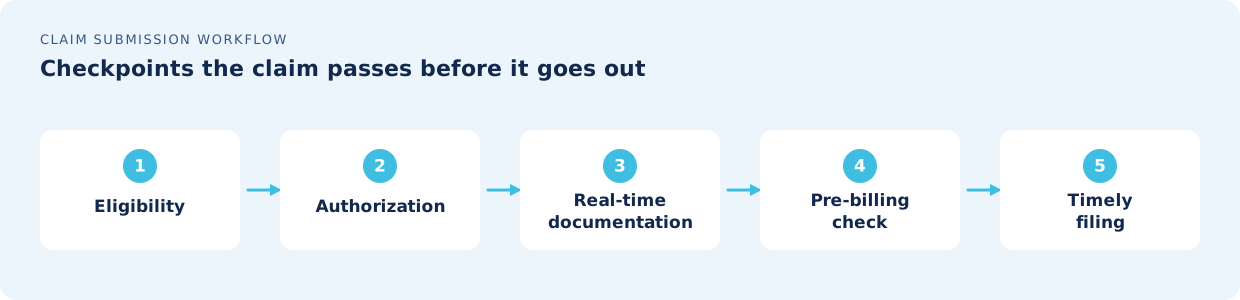
Payer-specific rules that trip practices up
A few coding and filing rules cause a disproportionate share of denials, and they're specific enough to build into the workflow. CMS built the National Correct Coding Initiative to promote correct coding and reduce improper payments, using two kinds of edits that ABA billing runs into constantly.
- Bundling and concurrent billing. Procedure-to-procedure edits define CPT code pairs that shouldn't be reported together except under defined circumstances. Concurrent billing of technician-delivered treatment and BCBA protocol modification ( is increasingly recognized by payers, but only when their rules are met and the correct modifiers are used.
- Unit caps (MUEs). A Medically Unlikely Edit is the maximum units of a code that a payer will reimburse for one provider, one client, and one date of service. If you bill above the cap the excess units will be denied. Some payers set stricter caps than the federal default, so check each one.
- Timely-filing windows. Medicare fee-for-service claims must be filed within one calendar year of the date of service to meet the Medicare timely filing rules. Medicaid and commercial payers set their own windows, often far shorter, and a missed window is a silent, unappealable loss.
Most of these rules vary by payer, which is the case for configuring them once rather than re-checking them per claim.
Prevention starts in the session note
Trace most denials back far enough and you reach the session note. Documentation that's vague, cloned across sessions, mismatched to the billed time, or silent on medical necessity becomes a denial once it meets a payer, which is exactly what the OIG audits found. That's why the front line of denial prevention isn't the billing desk. It's the note.
For what a compliant, audit-ready note requires, see ABA session note compliance. For the note itself and the objective data behind it, see choosing ABA collection methods.
Denial prevention vs. denial management
Denial management is the reactive work of reworking, appealing, and resubmitting claims after they're denied. Denial prevention is the proactive work of stopping the error before the claim is filed. Both matter, but they don't cost the same.
.svg)
When a denial does slip through, run a quick post-mortem so the same root cause doesn't repeat. You can usually find the breakdown by asking these five questions:
- Where in the lifecycle did it start?
- Was eligibility and authorization verified before the service?
- Did the note match the claim's units and codes?
- Was a coding rule like bundling, MUE, or a modifier missed?
- Was it filed inside the payer's window?
The answer points straight to the step in the workflow that needs attention.
How Office Puzzle helps
Office Puzzle fully connects scheduling, clinical data, session notes, and billing inside a single platform, so nothing falls through the cracks between a session happening and a claim getting paid. Documentation and billing information move together automatically, closing the gaps where denials usually start.
If you want to experience a connected workflow for your own claims try Office Puzzle free for 30 days, no credit card required. Want to see a walkthrough first? Book a demo.
Frequently asked questions
Why do ABA claims get denied?
ABA claims are most often denied for a handful of specific root causes. Usually, the client wasn't eligible or coverage lapsed, the service exceeded or lacked an authorization, or the documentation didn't support medical necessity or match the claim. Other times, the coding was wrong due to concurrent-billing and bundling errors, or the claim simply missed the timely-filing window.Most of these start before the claim is submitted, which is why prevention works better than appeals.
What is the most common reason ABA claims are denied?
Authorization problems are among the most common and costly. A claim is typically denied when the service was delivered without an active authorization or after the approved hours were used up. Because clinicians usually can't see authorization status during a session, the fix is operational: make remaining authorized hours visible at scheduling so services aren't delivered outside approved limits.
How do you prevent ABA claim denials?
You can prevent denials by catching the cause before the claim goes out. This means verifying eligibility and authorization before each service, documenting in real time with notes that match the billed units and codes, running a pre-billing check, and filing within the payer's window. The most reliable prevention connects scheduling, authorization, documentation, and billing so an error in one area is caught in the others rather than discovered after a denial.
Can a denied ABA claim be appealed and recovered?
Yes. Most denied ABA claims can be appealed, typically within a window of roughly 30 to 180 days depending on the payer, with corrected documentation. But appeals cost staff time and delay cash flow, and not every denial is recoverable. Recovering a denial is almost always more expensive than preventing it, which is why a prevention workflow is invaluable.
What is the difference between denial prevention and denial management?
Denial management is the reactive work of reworking, appealing, and resubmitting claims after they're denied. Denial prevention is the proactive work of stopping the error before the claim is filed. It relies on verifying eligibility and authorization, aligning documentation with codes, and checking claims before submission. Both matter, but prevention protects more revenue for less effort.
Sources
- Association for Behavior Analysis International. (2019). 2019 CPT codes for Applied Behavior Analysis. https://www.abainternational.org/welcome.aspx
- Centers for Medicare & Medicaid Services. (2021). Medicaid documentation for behavioral health practitioners [Fact Sheet]. U.S. Department of Health and Human Services. https://www.cms.gov/files/document/medicaid-documentation-behavioral-health-practitioners.pdf
- Centers for Medicare & Medicaid Services. (2025). Medicare claims processing manual: Chapter 1 - General billing requirements (42 CFR 424.44). U.S. Department of Health and Human Services. https://www.cms.gov/regulations-and-guidance/guidance/manuals/downloads/clm104c01.pdf
- Centers for Medicare & Medicaid Services. (2026). Medicare NCCI FAQ library. U.S. Department of Health and Human Services. https://www.cms.gov/medicare/coding-billing/national-correct-coding-initiative-ncci-edits/medicare-ncci-faq-library
- Centers for Medicare & Medicaid Services. (2026). National Correct Coding Initiative (NCCI) edits. U.S. Department of Health and Human Services. https://www.cms.gov/medicare/coding-billing/national-correct-coding-initiative-ncci-edits
- Office of Inspector General. (2024). Indiana made at least $56 million in improper fee-for-service Medicaid payments for Applied Behavior Analysis provided to children diagnosed with autism (Report No. A-09-22-02002). U.S. Department of Health and Human Services. https://oig.hhs.gov/reports/work-plan/browse-work-plan-projects/srs-a-25-029/
- Office of Inspector General. (2026). Audits of Medicaid Applied Behavior Analysis for children diagnosed with autism (Audit Series No. SRS-A-25-029). U.S. Department of Health and Human Services. https://oig.hhs.gov/reports/work-plan/browse-work-plan-projects/srs-a-25-029/