
Event recording is probably the first data method you ever used, even if no one called it that. See the behavior, make a mark. See it again, make another. That’s it, at its core.
The catch is that a simple tally gets slippery in a real session, when you’re prompting, managing materials, and keeping a learner engaged all at once. This guide walks through what event recording is, exactly how to collect it while you’re running a session, the tools that make it easier, and when a different method would serve you better.
Key takeaways
- Event recording means tallying a behavior each time it happens during an observation period. It produces a count, which behavior analysts call frequency.
- It fits discrete behaviors with a clear start and end that are not too fast to count, like hand raises, requests, or hitting.
- Two things make or break event recording: a clear definition of what counts, and marking each occurrence the moment it happens rather than from memory later.
What is event recording in ABA?
Event recording in ABA is a measurement procedure where you record each time a target behavior occurs during a set observation period. Every time the behavior happens, you mark it once. At the end, you have a count of how many times it occurred.
That count is what behavior analysts call frequency, a count of occurrences. If you also note how long you observed, the count can become a rate, which is occurrences per unit of time. Event recording is the procedure. Frequency and rate are what you do with the numbers it produces. For the difference between count and rate and how to calculate it, read about frequency and rate recording in our ABA Data Collection guide.
What behaviors fit event recording
Event recording works best for discrete behaviors, meaning behaviors with a clear beginning and end that you can count one at a time. Hand raises, vocal requests, instances of hitting, and completed tasks are all good fits. Behaviors that run continuously, blur together, or happen too fast to catch each one are a poor fit, and the section on other methods covers what to use instead.
How to collect event recording data, step by step
Here is the whole procedure, start to finish:
- Know exactly what counts. Start from the operational definition so you, and anyone else on the team, would mark the same event the same way. A clear definition is what keeps your data aligned with what the Ethics Code for Behavior Analysts considers accurate and reliable.
- Pick a tally method you can use without looking away from the learner.
- Mark each occurrence the moment it happens. One occurrence, one tally.
- Note when the observation started and ended, so your count can become a rate later.
- Transfer or sync your count before the session details fade.
Tools for tallying in the moment
Any of these work. The right one is whichever lets you record without taking your attention off the learner.
|
Tool |
How it works |
Best for |
|---|---|---|
|
Hand or golf counter |
Click once per occurrence, read the total at the end |
Fast counting without looking down |
|
Tally sheet on a clipboard |
Mark a tally for each occurrence |
A paper trail and notes on what happened around it |
|
Beads or a wristband |
Move one bead or band per occurrence |
Discreet counting when a device would distract |
|
One-tap counter in an app |
Tap a button per occurrence; it timestamps and totals |
Automatic totals, rate from session length, and syncing |
Common mistakes to avoid
- Reconstructing the count from memory at the end. Real-time marking is best practice.
- Missing occurrences that come in a fast burst. Decide in advance how to handle bursts.
- Working from a vague definition, so your count does not match a teammate’s.
- Forgetting to note the observation time, which leaves a count you cannot turn into a rate.
When event recording isn’t the right fit
Event recording shines for countable behaviors, but it is not the answer for everything. When the length of a behavior is what matters, like time on task or the length of a tantrum, duration and latency recording is the better measure. When the delay before a response is the goal, latency recording fits, and that same guide covers it. When a behavior happens so fast or so continuously that you cannot catch each instance, or you are tracking several behaviors at once, an interval recording and time sampling method gives a workable estimate.
Event recording, like duration and latency, is a continuous vs discontinuous measurement method, which records every instance rather than sampling. Continuous recording is the approach behavior-analytic research relies on most and was used in 55% of reviewed JABA studies of free-operant behavior. For the full method picker, see the ABA data collection methods hub in our ABA data collection guide].
How software makes event recording easier
The hardest part of event recording is marking every occurrence without breaking your focus on the client, and that is where a good tool earns its place. A one-tap counter in an ABA data collection app records each occurrence with a thumb tap, timestamps it, and pulls the session length automatically, so your count turns into a rate with no math. Because it is on the phone or tablet you already carry, you can record in the moment across home, school, and community sessions instead of copying tallies over later. Office Puzzle keeps event data, the rest of your session data, and your graphs in one place, so nothing gets re-entered. Want to see for yourself? Book a demo or start a free 30-day trial.
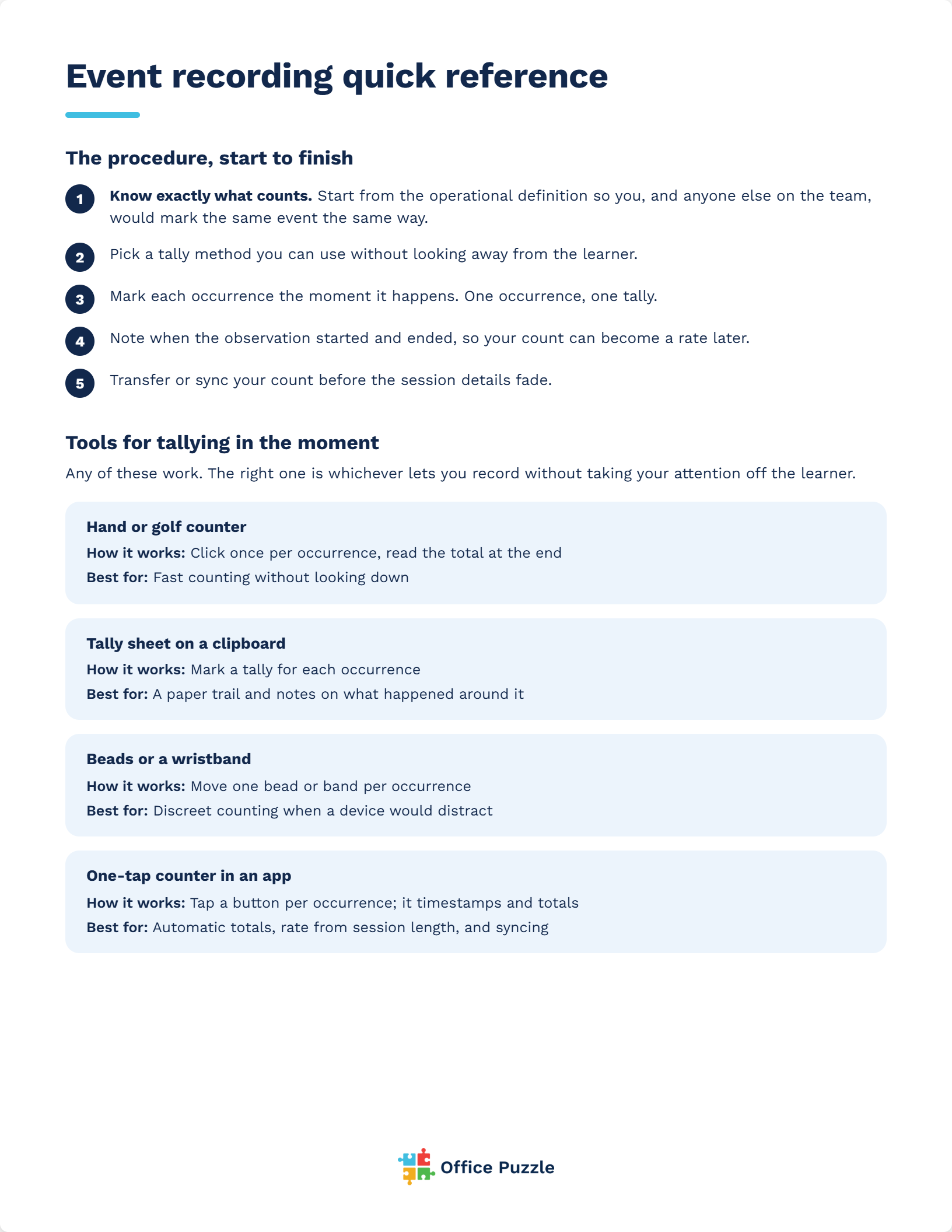
See below for our event recording quick reference and tally sheet.
Frequently asked questions
What is event recording in ABA?
Event recording is a measurement method where you tally a behavior each time it occurs during an observation period. The result is a count of how many times the behavior happened, which you can turn into a rate if you also track the observation time.
What is the difference between event recording and frequency recording?
Event recording is the procedure, the act of tallying each occurrence. Frequency is the count that procedure produces. People often use the terms together, since event recording is the most common way to collect frequency data.
Which behaviors are best measured using event recording
Discrete behaviors with a clear start and end that are quick to count, such as hand raises, requests, or hitting. It is a poor fit for behaviors that last a long time, blur together, or happen too fast to catch each one.
What tools do you need for event recording?
A clear definition and something to tally with. That can be a handheld counter, tally sheet, beads or a wristband, or a one-tap counter in a data collection app that totals and timestamps for you.
References
- Behavior Analyst Certification Board. (2020). Ethics code for behavior analysts. https://www.bacb.com/wp-content/uploads/2022/01/Ethics-Code-for-Behavior-Analysts-240830-a.pdf
- Carr, J. E., Nosik, M. R., & Luke, M. M. (2018). On the use of the term 'frequency' in applied behavior analysis. Journal of Applied Behavior Analysis, 51(2), 436–439. https://doi.org/10.1002/jaba.449
- Mudford, O. C., Taylor, S. A., & Martin, N. T. (2009). Continuous recording and interobserver agreement algorithms reported in the Journal of Applied Behavior Analysis (1995–2005). Journal of Applied Behavior Analysis, 42(1), 165–169. https://pmc.ncbi.nlm.nih.gov/articles/PMC2649837