
Starting an ABA practice is one of the biggest moves a BCBA can make, and it rarely falls apart for clinical reasons. The operational side is where most new owners struggle.
With so much to monitor: the business setup, provider IDs, payer paperwork and compliance rules – it can be hard to know where to even start.
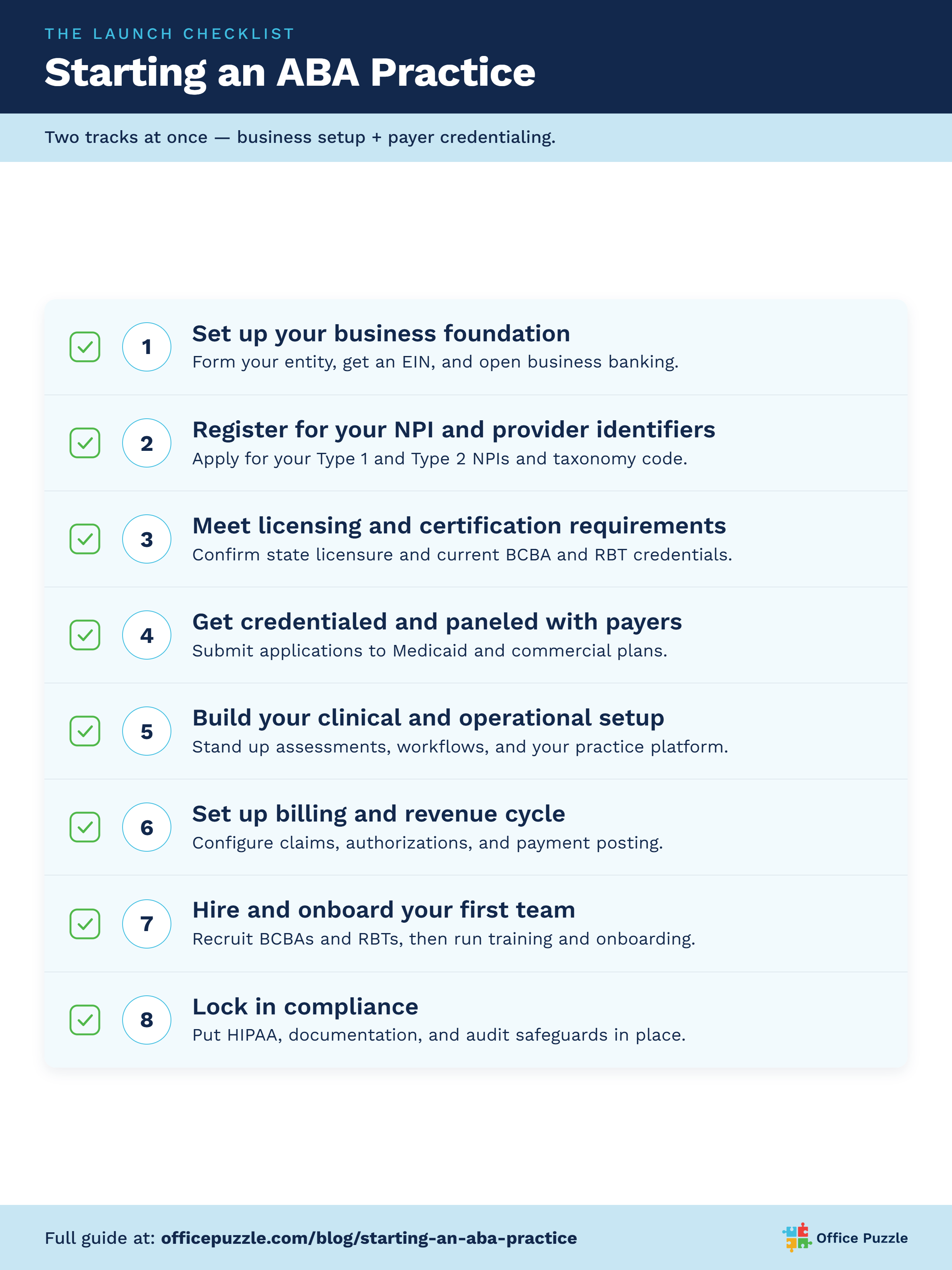
This step-by-step checklist walks through what starting an ABA practice takes, from forming the business to billing for your first client, so you can move in the right order and avoid the delays that catch new owners off guard.
Key takeaways
- Starting an ABA practice runs on two tracks at once: the business and legal setup, and the payer credentialing that lets you bill. Begin both early, because credentialing is the slowest piece.
- You'll need a business entity, an NPI, the right license and certification for your state, payer contracts, and a HIPAA-compliant clinical and billing workflow before you can treat and bill for your first client.
- The order matters. Your NPI depends on your entity, your credentialing depends on your NPI and license, and your first paid claim depends on all of it. A clear sequence keeps one delay from stalling everything.
Before you start: what opening an ABA practice takes
Opening a practice is really two projects running in parallel:
- Business and clinical foundation: the entity, the identifiers, the licenses, and the day-to-day systems.
- Payer credentialing: the process that lets you bill insurance and Medicaid for care.
Some steps are sequential and some overlap. You can register your business while you study licensing rules, but you can't get credentialed until your NPI and license are in hand. Most new practices take several months to launch, and credentialing is usually what sets the timeline.
Step 1: Set up your business foundation
Start with the legal and financial shell of the practice. Most owners form an LLC or a professional entity so their personal assets stay separate from the practice's liabilities. The right structure affects your taxes and your personal risk, so it's worth a conversation with an attorney or accountant before you file.
From there, register the business with your state and get a federal tax ID. Open a business bank account, and line up professional liability and general business insurance. These basics make everything downstream, from your NPI to your payer contracts, cleaner to complete.
Step 2: Register for your NPI and provider identifiers
Any provider who bills electronically needs a National Provider Identifier (NPI), the standard ten-digit number Centers for Medicare and Medicaid Services (CMS) assigns to health care providers. Most group practices need two: an individual NPI for each clinician, and an organizational NPI for the practice itself.
Applying is free, and the online application through National Plan and Provider Enumeration System (NPPES) is the fastest route. Your NPI ties your business identity to every claim you'll submit later, so complete this before you approach payers.
Step 3: Meet licensing and certification requirements
Clinical care has to be led by a qualified professional. A Board Certified Behavior Analyst credential requires:
- a graduate degree
- supervised fieldwork
- a passing score on the BACB exam
- along with ongoing adherence to the profession's ethics code.
On top of certification, many states license behavior analysts separately, and the requirements vary from state to state. Check your state's licensing board early, because a missing license will stall your payer credentialing. Local business licenses and permits may apply too, depending on where you operate.
Step 4: Get credentialed and paneled with payers
Credentialing verifies your qualifications. Paneling, or enrollment, is what gets you in-network and set up to be paid. They're related but separate, and both take time.
Most commercial payers pull your information from the CAQH Provider Data Portal, so building and attesting a complete profile there comes first. Each payer then runs its own review, and Medicaid enrollment is a separate, state-run process. Credentialing and paneling often run for several months and are the most common bottleneck in a launch, so start the moment your NPI and license are ready.
Step 5: Build your clinical and operational setup
With the legal and payer groundwork moving, set up how the practice will run day to day. That means: intake, scheduling, data collection, session documentation, and supervision. These are the workflows your team will touch every single day, so they're worth getting right before your caseload grows.
New owners often start with a patchwork: a calendar in one place, a data app in another, notes in a third, billing somewhere else. Consolidating scheduling, data collection, documentation, and billing tools into one app keeps information from falling through the gaps between systems. For the clinical side of data collection specifically, see our ultimate guide to ABA data collection.
Step 6: Set up billing and revenue cycle
Billing is where a new practice either gets paid on time or spends its first year chasing denials. Clean claims depend on your notes and schedules feeding billing without anyone re-keying data by hand.
Get familiar with the ABA billing codes for each service you'll provide, your payers' authorization rules, and how you'll track claims from submission to payment. Building this early, rather than after the first denial, protects your cash flow.
Step 7: Hire and onboard your first team
As caseload grows, you'll bring on RBTs to deliver direct care under BCBA supervision, and eventually more BCBAs. Hiring is one thing. Onboarding them into your workflows, and tracking their credentials and renewals so nothing lapses, is what keeps the practice compliant and running.
Plan for how you'll handle recruiting, onboarding, and supervision before you're understaffed and hiring in a hurry.
Step 8: Lock in compliance
Compliance isn't a one-time task, and it's the area where new owners are most exposed. As a health care provider that transmits information electronically, your practice is a HIPAA covered entity, regardless of its size. That means following the HIPAA Privacy Rule and the Security Rule's safeguards for electronic protected health information.
If you deliver Medicaid-funded services in a client's home, electronic visit verification (EVV) is a federal requirement under the 21st Century Cures Act. Rules vary by state so be sure to seek out the correct information for your area.
Build record-keeping, authorization tracking, and audit readiness into your systems from the start, so compliance is something your workflow handles rather than something you scramble for later.
How Office Puzzle helps new practice owners
Starting an ABA practice means wearing every hat at once. Office Puzzle is an all-in-one ABA practice management platform that brings scheduling, data collection, documentation, and billing tools into one place, so a new owner isn't stitching together separate systems for each part of the work.
Pricing is flat per user with all features included and no long-term contract, which keeps costs predictable as you add staff. EVV comes built in as a safeguard for Medicaid-funded in-home services, and the platform works across mobile devices. More than 800 ABA practices nationwide run on it today.
You can try it free for 30 days with your own practice data, or book a demo to see how it fits your workflow. Starting an ABA practice is a lot to coordinate, but a clear checklist and one connected system make the launch far more manageable.
Frequently asked questions
How long does it take to start an ABA practice?
Most new ABA practices take several months to launch, and payer credentialing is usually the longest step. Business formation and your NPI can move in days to weeks, but credentialing and paneling with payers commonly run for months, so that stage sets the real timeline. Starting credentialing as early as possible is the single best way to shorten the wait to your first paid client.
Do you need to be a BCBA to open an ABA practice?
The business owner doesn't have to personally hold the credential, but the practice's clinical care must be led by a qualified professional, typically a Board Certified Behavior Analyst. Many states also require a licensed behavior analyst to oversee services, so a BCBA is essential to the clinical side even when the owner's role is on the business side.
How much does it cost to start an ABA practice?
Startup costs vary widely by state, practice size, and setup. The main categories are business formation and insurance, practice management software, and staffing. Because credentialing delays revenue, plan for several months of operating costs before payer reimbursements start arriving.
What do you need to run an ABA practice day to day?
Day-to-day operations run on scheduling, data collection, session documentation, supervision tracking, and billing. New owners increasingly consolidate these into one ABA practice management app rather than juggling separate tools, which cuts down on re-keying and keeps records audit-ready.
References
- Behavior Analyst Certification Board. (2026). Board Certified Behavior Analyst handbook. https://www.bacb.com/wp-content/uploads/2025/08/BCBAHandbook_260130-a.pdf
- Centers for Disease Control and Prevention. (2026). Health Insurance Portability and Accountability Act of 1996 (HIPAA). https://www.cdc.gov/phlp/php/resources/health-insurance-portability-and-accountability-act-of-1996-hipaa.html
- Centers for Medicare & Medicaid Services. (n.d.). Electronic visit verification. Medicaid.gov. https://www.medicaid.gov/medicaid/home-community-based-services/home-community-based-services-guidance-additional-resources/electronic-visit-verification
- Centers for Medicare & Medicaid Services. (n.d.). How to apply for a National Provider Identifier (NPI). https://www.cms.gov/medicare/regulations-guidance/administrative-simplification/how-apply
- Council for Affordable Quality Healthcare. (n.d.). CAQH Provider Data Portal for clinicians. https://www.caqh.org/providers
- U.S. Department of Health and Human Services. (n.d.). The HIPAA Privacy Rule. https://www.hhs.gov/hipaa/for-professionals/privacy/index.html
- U.S. Department of Health and Human Services. (n.d.). The Security Rule. https://www.hhs.gov/hipaa/for-professionals/security/index.html
- U.S. Small Business Administration. (n.d.). Choose a business structure. https://www.sba.gov/business-guide/launch-your-business/choose-business-structure
- U.S. Small Business Administration. (n.d.). Register your business. https://www.sba.gov/business-guide/launch-your-business/register-your-business