In today’s ABA practices, data is the foundation of everything you do. You use it to measure progress, celebrate achievements, and find new ways to help clients grow. Electronic Visit Verification (EVV) is simply another way to bring that commitment to accuracy into your daily routines.
EVV isn’t just another regulatory hoop to jump through. Used well, it helps build trust with families and ensures every minute of therapy is documented and valued. With the right system, EVV gives you a clear record of the care your team provides. No guesswork needed.
Key takeaways:
- EVV is a federal compliance requirement that digitally records the who, what, where, and when of every ABA therapy session — primarily to reduce fraud and protect Medicaid billing.
- Fragmented systems create problems. When EVV, clinical notes, and billing live in separate tools, manual data-matching increases errors, claim denials, and administrative burden.
- Integrated EVV saves time and money. A unified platform automates verification across scheduling, documentation, and billing, leading to faster reimbursements and fewer compliance headaches.
What is EVV in ABA therapy?
EVV is like a digital receipt for a therapy session. It creates a reliable record of care for providers, families, and payers.
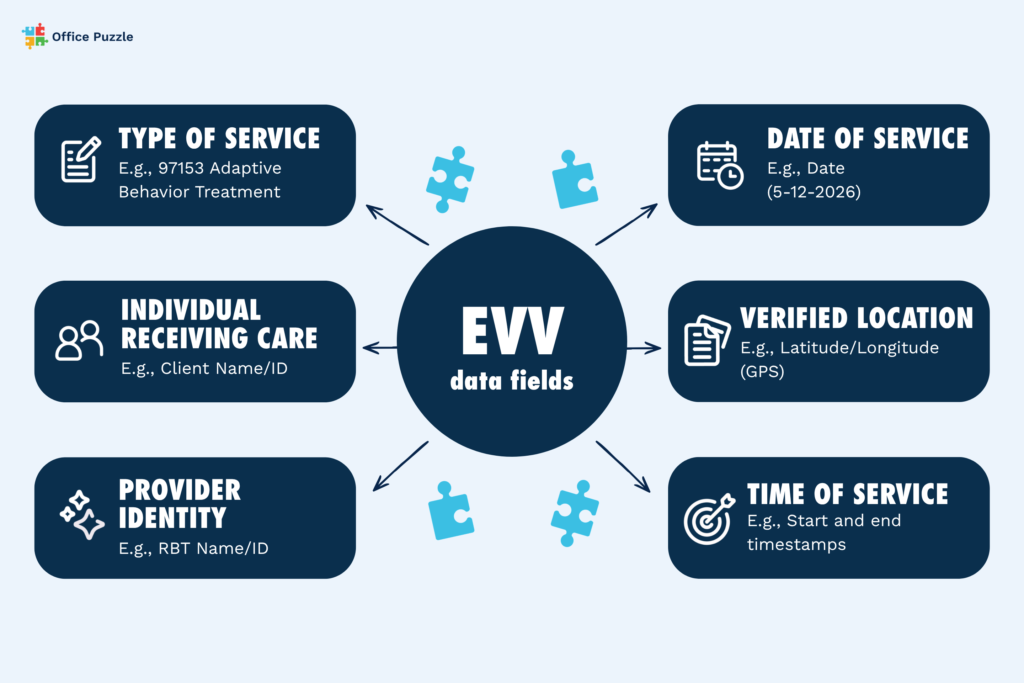
By capturing the who, what, where, and when of every encounter, EVV creates a clear, factual history of the care provided.
What EVV in action looks like:
- Clinician: When an RBT arrives at a client’s home, they check in via a mobile device. The system automatically logs the exact start time and GPS coordinates. This action verifies the clinician has arrived and is ready to support the client.
- Operations: Staff double-checks that EVV data matches notes and billing, making sure there are no discrepancies. Even a small mismatch can slow down payments or trigger an audit.
Why EVV exists for ABA providers
The federal mandate for EVV originates from the 21st Century Cures Act. The EVV requirements are managed at the federal level and its implementation is handled by individual states. Because of this, your practice should verify your state specific mandates.
EVV was designed to modernize healthcare verification. It exists for several reasons that directly impact how ABA agencies operate:
- Fraud reduction and accuracy: EVV aims to reduce billing fraud and improve the overall accuracy of Medicaid service verification.
- Verification of in-home care: Because ABA therapy is largely delivered in-home or in community-based settings, many states require EVV to confirm services are delivered as documented outside of a traditional clinic.
- Revenue protection: It provides objective proof that a service occurred at the correct time and place, turning your documentation into a safeguard for your practice’s revenue.A common example are Medicaid-funded ABA sessions. These sessions require verifiable proof that the RBT was present and providing therapy as scheduled. EVV automatically provides that data trail, protecting the practice from audit risks.
When your practice treats EVV as a core part of your workflow it helps your billing stay smooth and compliant.
What data must be captured for EVV compliance
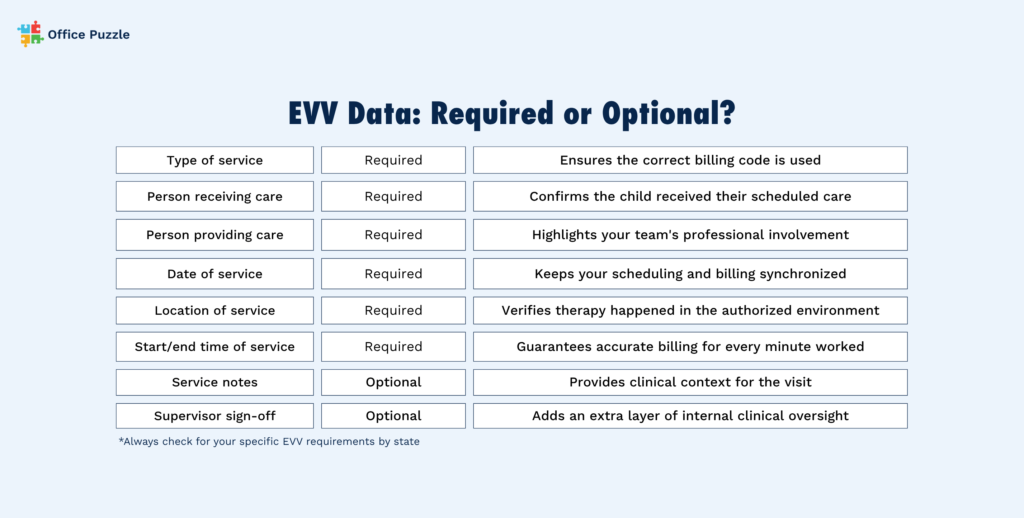
To maintain solid record-keeping and remain compliant, your system must capture six essential data points for every session. This ensures that every claim you submit is accurate and fully supported by your EVV data.
While federal law requires six core data points, some agencies go further and collect extra information to make billing and clinical work even smoother. Here’s what’s required, what’s optional, and why it matters:
How EVV Impacts ABA Daily Workflows
EVV isn’t a standalone task. It connects your entire session lifecycle. The system needs a match across three key stages: scheduling, service delivery, and billing. EVV work really starts the moment you put a session on the calendar and only ends once the claim is paid.
This integration fundamentally changes how your team interacts with their tools and clients every day:
- Scheduling: The schedule sets the authorized time and location that the EVV system will later use for verification.
- Service delivery: The RBT completes a digital check-in on a mobile device and receives an official time and location stamp.
- Billing: It automates the verification process previously performed manually by the billing team, ensuring that the documentation and the EVV are aligned.
Example: At the beginning of a session, an RBT must complete the EVV check-in before starting direct therapy with a client. This ensures that the exact time and GPS location are verified before the first clinical note is even written.The way you set up your workflow makes or breaks the EVV experience. When it fits naturally into your team’s routine, it takes the headache out of paperwork and lets everyone focus on what matters: helping clients.
Common challenges with EVV in ABA practices
While EVV provides a necessary layer of verification, the way a practice implements it can create significant hurdles. A common source of friction is system fragmentation. This is where the data exists in separate silos rather than a single stream. This can be caused by:
- Disconnected tools: Many agencies manage EVV, clinical documentation, and billing through separate platforms.
- Administrative heavy lifting: This fragmentation forces office staff to manually transfer data between systems, which could increase their workload and heighten the probability of errors.
- Verification Gaps: When platforms aren’t connected to each other, confirming that every session has a valid EVV record may require extra work, such as a manual audit.
What common EVV challenges look like in ABA practices:
A session is captured perfectly in a standalone EVV app, but because that data doesn’t sync with the billing software, the claim is submitted without the required verification. This leads to an immediate claim denial or an audit flag, requiring hours of tedious work to resolve.
If your systems don’t talk to each other, you’re opening the door to compliance problems and lost revenue. The solution: Make EVV a built-in part of your technology, not just something tacked on at the last minute.
Manual EVV vs. integrated EVV systems
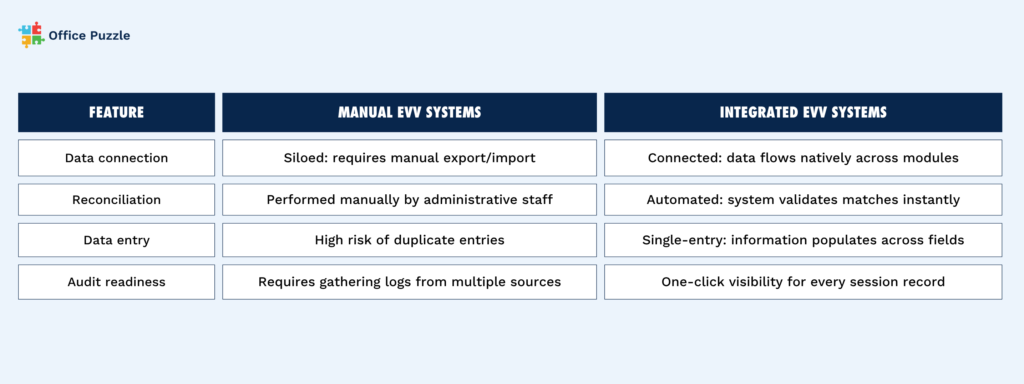
Choosing how to implement EVV can come down to the difference between a stand-alone tool and a unified workflow. While both meet the compliance requirements, the impact on your back-office efficiency is vastly different.
- Manual EVV systems: These typically involve separate check-in apps that operate independently of your other software. Because the data isn’t shared, manual reconciliation is required. Your staff must cross-reference EVV logs against clinical notes and billing claims by hand.
- Integrated EVV systems: These connect every phase of the session into a single stream. Data moves automatically from one stage to the next, removing the need for human intervention to match records.
Best Practices for EVV implementation in ABA
Successful implementation relies on clear expectations and routine maintenance. When everyone follows the same playbook, the data becomes a reliable asset rather than a source of stress.
- Standardize procedures: Establish a uniform start-of-session and end-of-session routine. Whether it’s an RBT in a home or a supervisor at a clinic, the check-in process should be identical across all staff roles to eliminate confusion.
- Invest in hands-on training: Don’t just send out a manual. Provide interactive training for RBTs and supervisors on mobile use. Highlight how they should handle common field issues, such as low connectivity or a dead battery. By doing this, you empower your staff to stay compliant without clinical interruptions.
- Establish a regular audit cadence: Compliance isn’t a one-and-done task. Schedule routine reviews of your EVV logs to identify accuracy issues or compliance gaps before they escalate into larger problems.
- Have the right technology on board: An all-in-one solution with built-in EVV ensures checks and balances are in place to trigger and automate compliance from scheduling to billing.
When developing your own processes remember that consistency beats complexity every time. A straightforward routine such as conducting a weekly EVV audit enables your team to catch missing timestamps or location mismatches in real time. With the right technology in place, you don’t have to carry this out manually, and you can prevent billing delays and reduce the likelihood of claim rejections to keep your practice running smoothly without additional effort.
How Office Puzzle simplifies EVV for ABA providers
Managing EVV requirements shouldn’t feel like a second job. Office Puzzle addresses the compliance requirements of the 21st Century Cures Act by providing built-in EVV functionality directly within its comprehensive ABA platform.
EVV management is streamlined through:
- Native integration: EVV connects directly to your scheduling, documentation, and billing workflows, allowing data to flow through your agency without manual intervention.
- Single source of truth: Because the platform manages every stage of the session lifecycle, there is no need to export data or cross-reference separate apps to verify a claim.
- Reduced error risk: By automating the match between a scheduled appointment and a verified check-in, the system lowers the probability of claim rejections.
Because Office Puzzle is a fully connected, all-in-one solution, you don’t have to juggle multiple systems and logins. RBTs can complete their EVV check-in within the same system they use to record session notes. And, the clinical documentation and digital receipt for the visit are linked in real time.
When everything’s in one place, you save your team from time-consuming processes that contribute to error. If you’re using manual or multiple systems, your practice can boost compliance and save time and money with the right technology in place. Try Office Puzzle free for 30 days.
A fully connected workflow, with built-in EVV
Modernizing your agency shouldn’t come with a steep learning curve or a restrictive contract. Office Puzzle offers a transparent, flexible solution designed specifically for the needs of ABA providers with:
- Affordable pricing: Just $19.99 per user, per month.
- No long-term contracts: Stay because you love the software, not because you’re stuck.
- Risk-free trial: Experience the full platform with a 30-day free trial.
EVV in ABA is more than compliance
While it’s easy to view EVV as a purely regulatory hurdle, the most resilient practices treat it as a foundational part of their operational infrastructure. When viewed through this lens, EVV stops being a burden and becomes a mechanism for validating the quality care your team provides.
Agencies that successfully integrate EVV into their workflows see immediate benefits beyond compliance. They experience:
- Reduced administrative load: Automating the verification process eliminates the need for manual cross-referencing and document sifting at the end of the month.
- Accelerated billing cycles: Verified data moves through the billing system faster, leading to more timely reimbursements and increased cash flow predictability.
- Data integrity: Having a single, unalterable record of service creates a reliable record of care and protects the agency during audits.
A better EVV system means less paperwork, faster payments, and more time for quality care. Investing in seamless integration helps your team and clients thrive.
Frequently Asked Questions (FAQ)
1. What is EVV for ABA therapy?
Electronic Visit Verification (EVV) is a digital system used to confirm that authorized services are delivered to the right person, at the right time, and in the right place prior to claim payment. Originally mandated by the 21st Century Cures Act, it serves as a digital receipt for every therapy session.
2. Do ABA providers need EVV for all services?
Not necessarily. Requirements depend heavily on your specific state regulations and the funding source.
- Medicaid services: Many states require EVV for all Medicaid-funded Personal Care Services (PCS) and Home Health Care Services (HHCS), which frequently include in-home ABA therapy.
- Private insurance: Some commercial payers are beginning to adopt similar verification standards to increase transparency.
- Location matters: EVV is primarily focused on in-home and community-based services. Clinic-based services may have different verification requirements depending on the state.
3. What information does EVV collect in ABA?
To satisfy federal compliance, an EVV system must capture six key data points:
- Client identity: The individual receiving the service
- Provider identity: The staff member providing service
- Service: The specific type of therapy being delivered (e.g., adaptive behavior treatment)
- Time: The exact start and end times of the session
- Date: The day the service was provided
- Location: The verified GPS coordinates or address where the session occurred
4. Can ABA agencies use manual EVV systems?
Agencies can use manual EVV systems, but standalone apps don’t sync with clinical software, forcing staff to move data by hand.
Keep in mind:
- Staff must copy and paste timestamps and locations from the EVV tool into the billing software. This increases the risk of human error and mismatched data.
- Admin teams spend hours every week reconciling these records by hand. The extra work could delay the billing cycle and increase overhead costs.
5. How does EVV affect ABA billing and reimbursement?
EVV directly impacts your revenue. In many states, you cannot submit a claim or receive payment unless it is supported by a verified EVV record.
- Example: If an RBT’s clinical note says a session started at 3:00 PM, but the EVV check-in was at 3:15 PM, the billing system will flag a mismatch. This prevents the claim from moving forward, leading to payment delays or audits that can tie up your agency’s cash flow.
References
- 21st Century Cures Act, Pub. L. No. 114-255, § 12006, 130 Stat. 1033 (2016). https://www.congress.gov/114/plaws/publ255/PLAW-114publ255.pdf
- Centers for Medicare & Medicaid Services. (n.d.). Electronic visit verification (EVV). Medicaid.gov. https://www.medicaid.gov/medicaid/home-community-based-services/home-community-based-services-guidance-additional-resources/electronic-visit-verification
- Medicaid.gov. (n.d.). EVV compliance status for personal care services by state or territory. https://www.medicaid.gov/medicaid/home-community-based-services/home-community-based-services-guidance-additional-resources/electronic-visit-verification/evv-compliance-status-for-personal-care-services-state-or-territory
- Texas Health and Human Services Commission. (n.d.). Electronic visit verification. https://www.hhs.texas.gov/providers/long-term-care-providers/long-term-care-provider-resources/electronic-visit-verification-evv
- Texas Health and Human Services Commission. (n.d.). Learn more about EVV [PDF]. https://www.hhs.texas.gov/sites/default/files/documents/learn-more–about-evv.pdf
- Medicaid.gov. (n.d.). EVV requirements workshop [PDF]. https://www.medicaid.gov/medicaid/home-community-based-services/downloads/evv-requirements-workshop.pdf